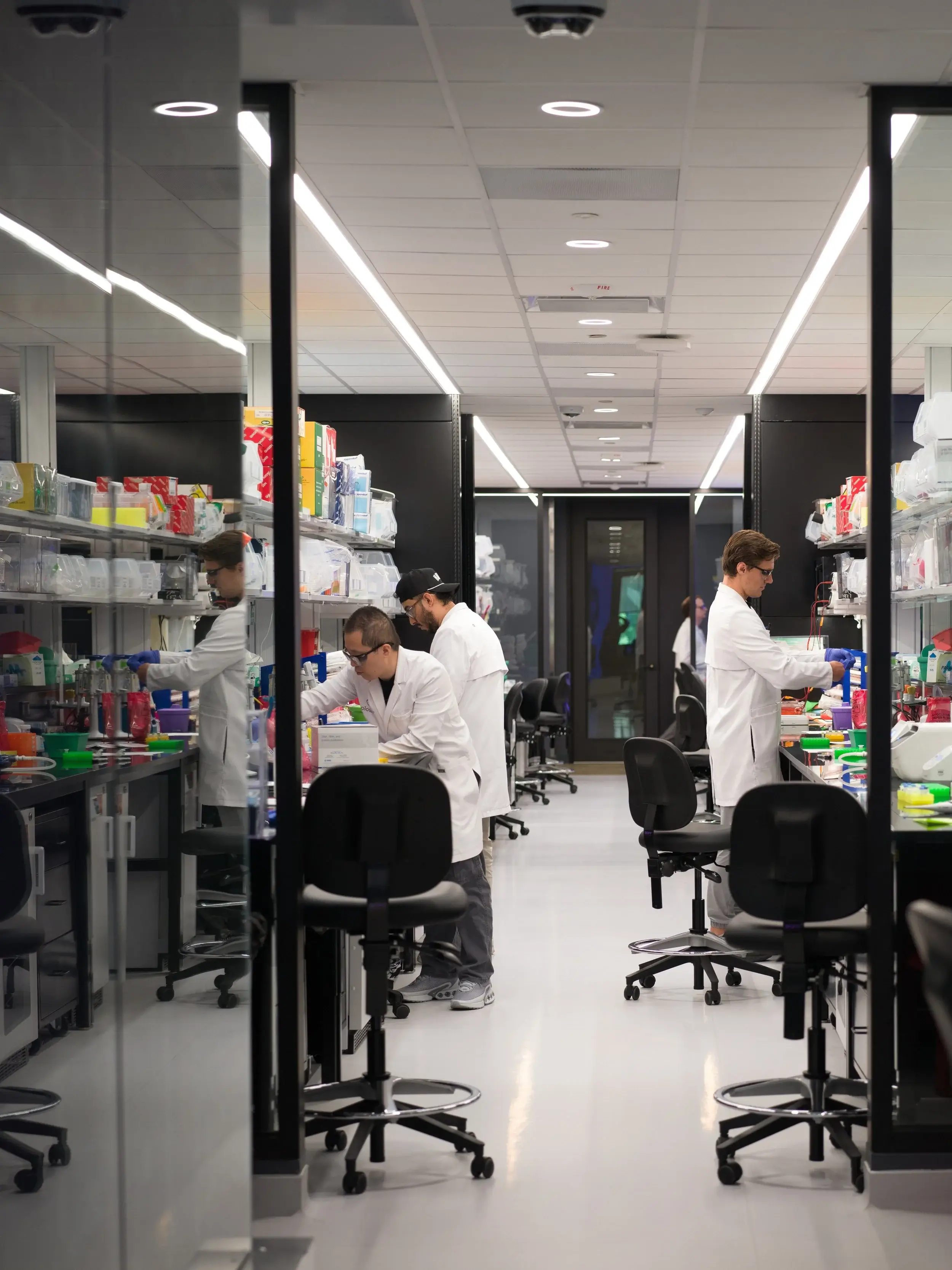
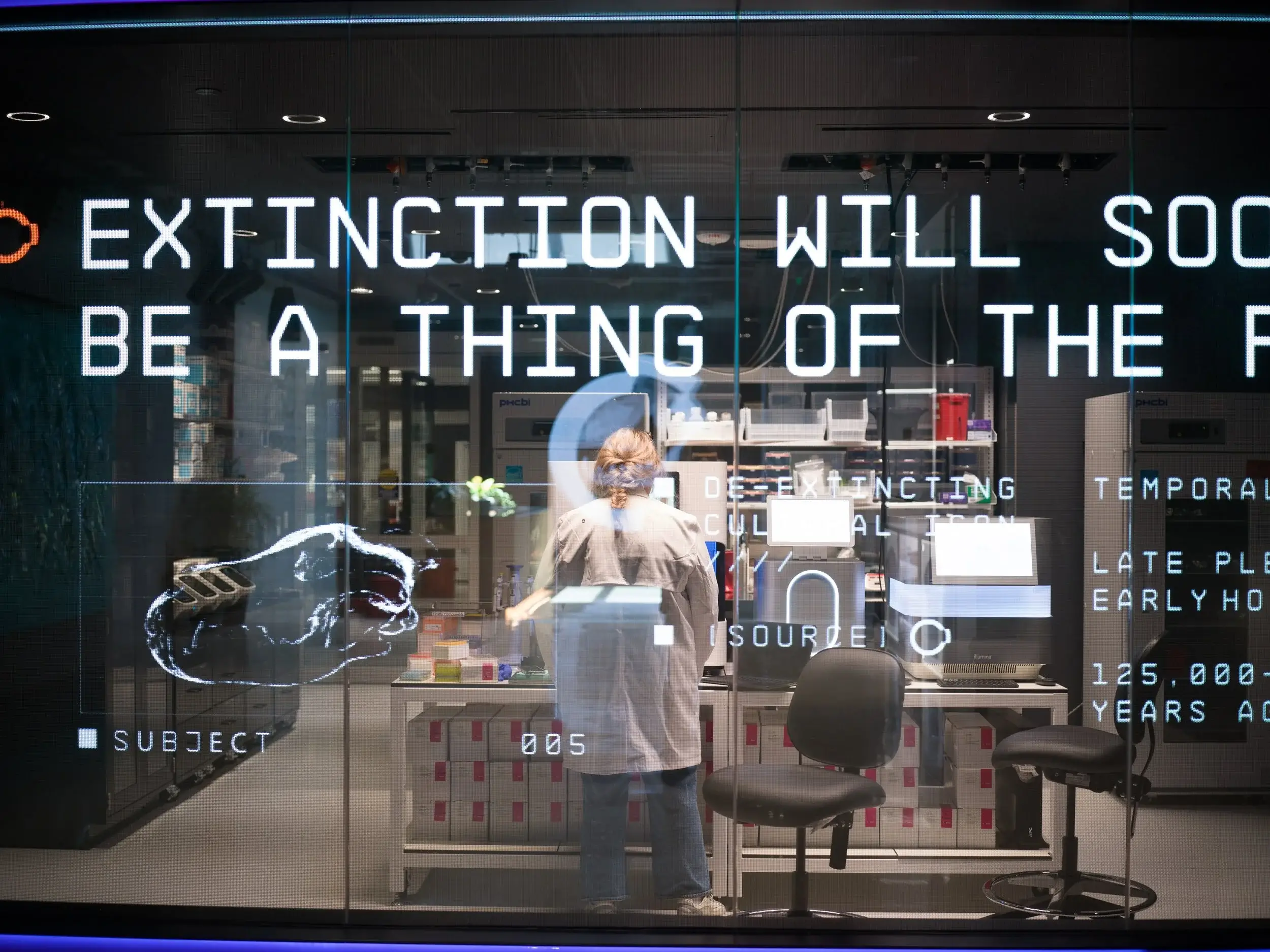
I visited Colossal Labs in July. It was Chernobyl weather—Dallas was cloaked in reddish-grey smog, emitting a nebulous sense of doom. I’m here to meet Ben Lamm, the American billionaire entrepreneur and co-founder of Colossal, and other members of the team. They’ve just moved into their permanent space, a sprawling new complex in an office park on the outskirts of Dallas. A bubbly office manager leads me through their new digs. Everyone seemed excited, but the vibe is super hush-hush. I feel like I’m in on a secret. The corridor to the lab glows with animated images of the lab’s animals-in-the-making; I’m reminded of meme coins. There’s a sculpture in the entryway: a gigantic mammoth, captured in ice that glows turquoise. Purple lighting, sleek black walls—it’s like a nightclub for scientists and their creations.
I perch on a leather bench in Lamm’s office. (He apologizes that they are still moving in.) Lamm made his fortune in tech—founding, selling, buying, and spinning off companies whose focus has, for the most part, been biological engineering and genetic technologies..
After the lab tour and three meetings, my colleague and I go searching for lunch. We decide the safest bet is a taco place, but it’s on the other side of the highway. We decide to bypass the highway by hiking through the back of the office complexes. She is in Prada flats. I admire her gumption. As we walk, scratched by reeds and sinking into the mush, I wonder aloud, “I bet a pack of dire wolves was here, like, right here.” Then my colleague points out a dead crow, mangled on the side of the highway. The tacos are terrible. We take an Uber back to the lab. We wait in what’s functionally a construction site. At 3 p.m., our meeting gets canceled.
Lamm’s self-identity as a computer programmer infuses all aspects of the company he co-founded. He and others retool and tinker with life. “I fundamentally believe that biology is just software,” he told me, invoking a well-worn trope in computer science: the cell is the hardware, the DNA the code, and evolution is the programming. According to Lamm, Colossal is reprogramming the code of life to create creatures like dire wolves. Lamm told me. “Biology is the most interesting, crazy coding language that we don’t fully yet understand.”
I like working with engineers because for them, every problem has a solution. There’s nothing that can’t be fixed, somehow. Of course, engineering the longest bridge in the world, say, is a completely different engineering than artificially evolving life. Ever the engineer, Lamm wants to find “nature-based solutions” to climate change. Lamm and his team’s tools at Colossal—DNA synthesis, genome engineering, and computational analysis—are ways to make engineering life more “efficient at evolution.” Today’s genetic engineering, as he sees it, is just in the beginning stages; soon, synthetic biology and AI will, according to Lamm, extend that engineering even beyond Earth. “We will have to become better geoengineers of this planet and then eventually off-world planets,” he said.
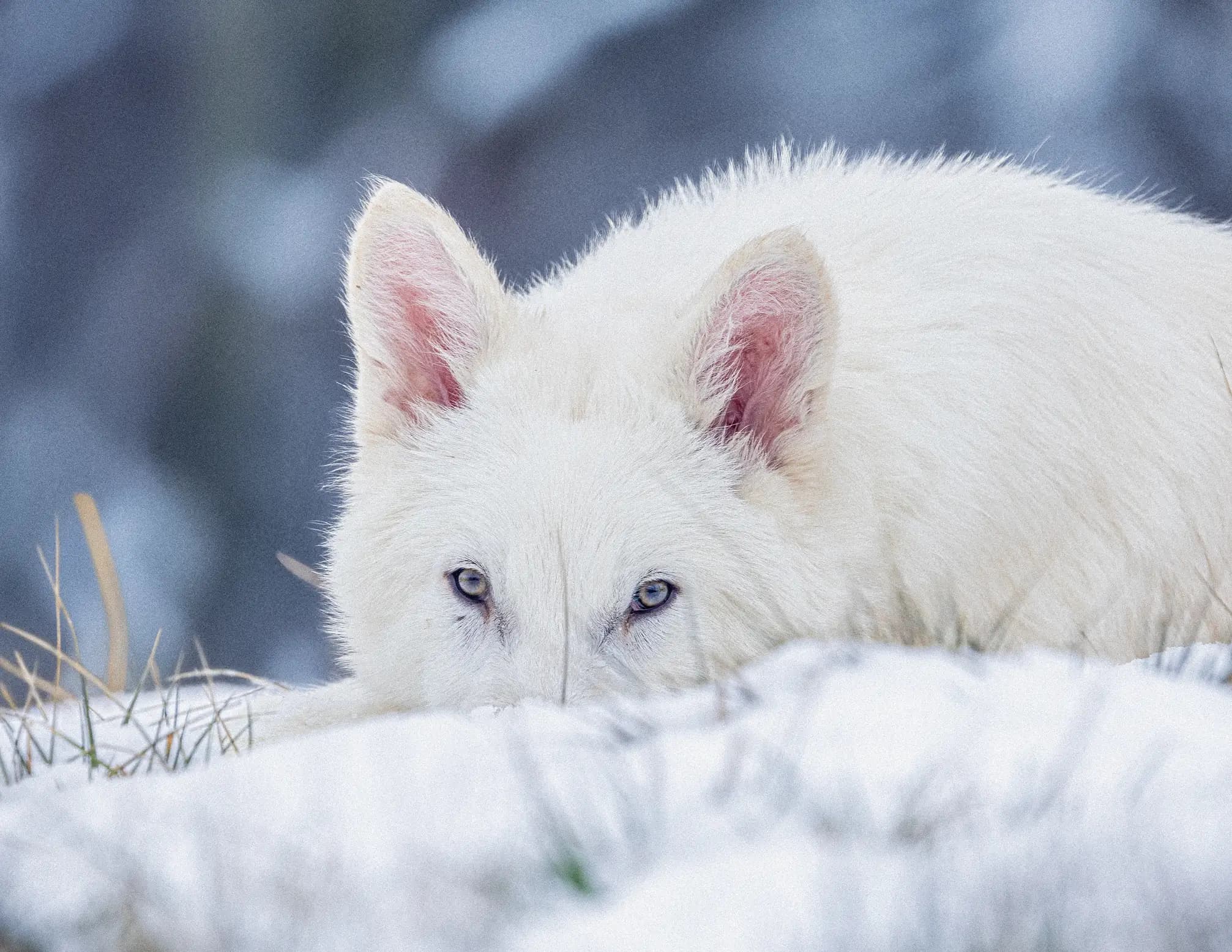
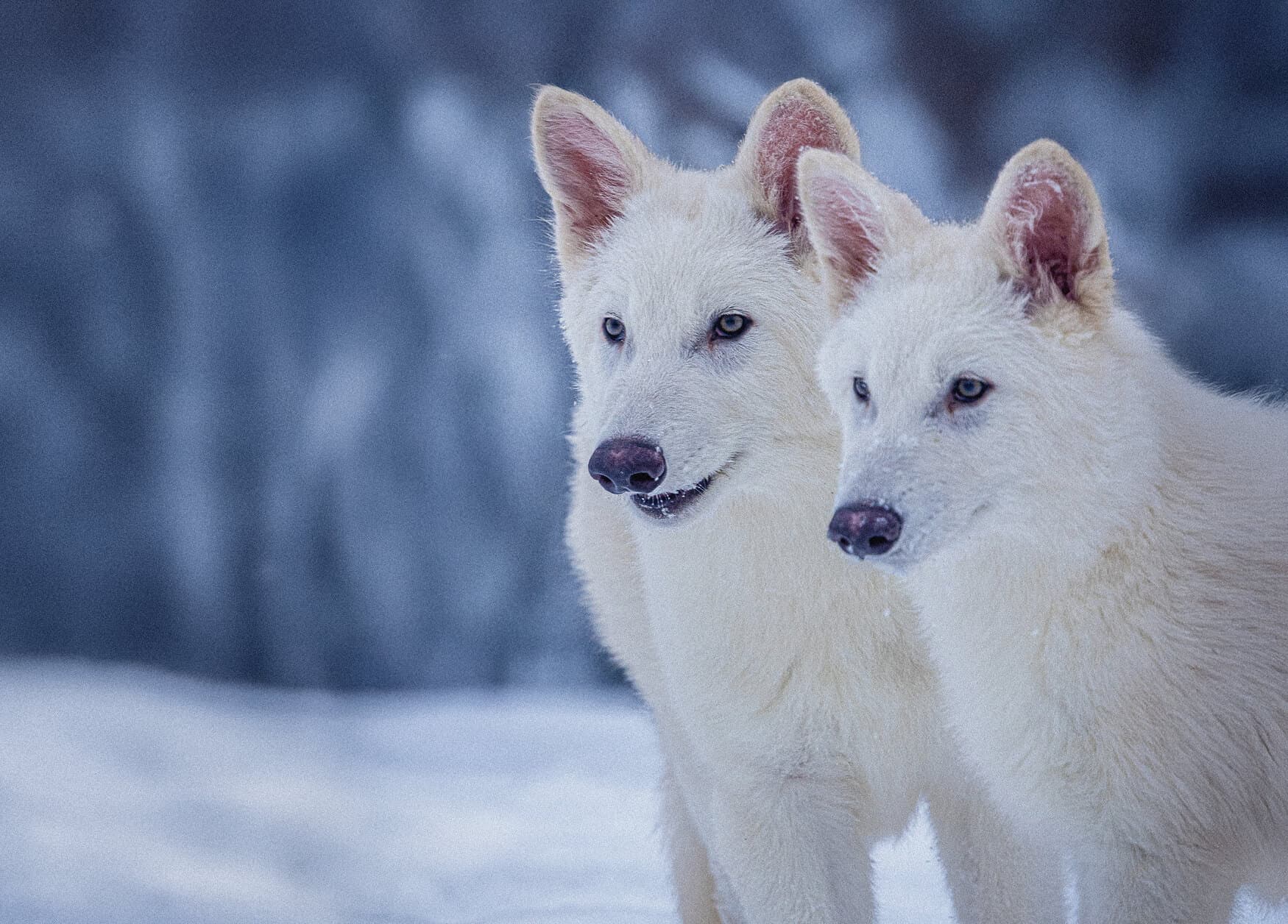
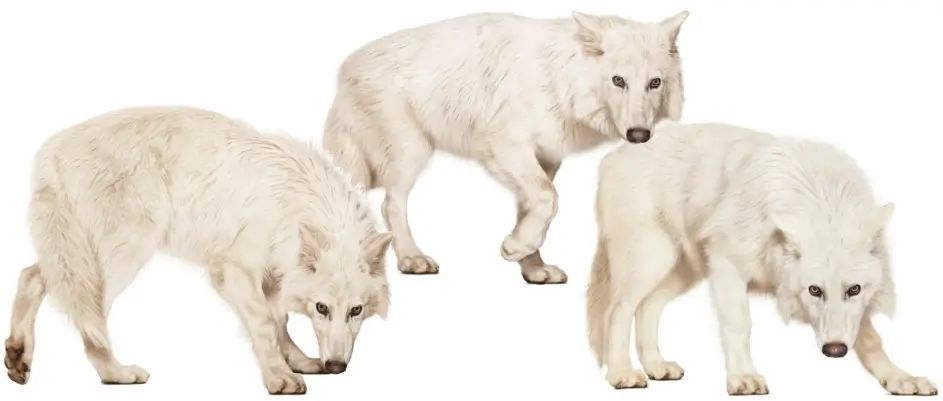
To make Romulus, Remus, and Khaleesi, Colossal researchers first scraped DNA from two dire wolf fossils: a 13,000-year-old tooth from Sheridan Pit, Ohio, and a 72,000-year-old inner ear bone from American Falls, Idaho. They then compared those fragments with the complete DNA sequence of a grey wolf, an extant evolutionary relation. They used CRISPR (Clustered Regularly Interspaced Short Palindromic Repeats—notice the linguistic reference here) to perform twenty base-pair edits on fourteen genes: LCORL for size; CORIN for a lighter coat; HMGA2 for skeletal morphology; and others, some of which are undisclosed to the public.
(Lindsey, the paleobiologist at the La Brea Tar Pits, is not impressed. “That they turned off their genes for color?,” she laughed. “People have made mice that glow in the dark. Making a white dog is not that impressive.”)
There are three categories of genes. First, they edited fifteen base pairs to be the exact same as those in dire wolves. Church called these the extinct traits: not just morphology, but genes unique to dire wolves. Second, the overwhelming majority of genes that remained the same (over four billion) from grey wolves. And third, the genes that Colossal chose to influence for other reasons: a white coat, a nolition for congenital pathologies.
It’s the first category that makes Romulus, Remus, and Khaleesi literally dire wolves. The base pairs that make them distinct, are, through CRISPR, altered from the grey wolf genome to be chemically identical to the extinct’s.
The edits, through CRISPR, aren’t like cutting and pasting. There’s a complex relationship between the genes and how they’re expressed—including the physical traits that appear. Dr. Christopher Mason is a Professor of Physiology and Biophysics and an advisor at Colossal. He told me the scattershot nature of these edits; Colossal had to balance the fabrication of an extinct species with many possible risks. Because multiple genes can code for the same trait, the edits were deliberate choices without guaranteed results. “We could have done, in theory, many serial rounds of selection. Could we just do five edits? What’s the right number? It could take thousands and thousands of changes to really create a new species,” he told me. “After a while we realized that it’s not about the number. Sometimes you only need a handful of edits to find a new species.”
Dr. Kathleen Morrill at Colossal: “Indeed, the genome engineering team at Colossal Biosciences edited 15 regulatory regions to exactly match the extinct dire wolf genome sequences identified by paleogenomic, genotype-to-phenotype, and comparative genomic analyses. There is not a precise answer to [X changes to Y gene] due to the intergenic nature of gene-regulatory effects…This includes regulatory sequences affecting MSRB3 and HMGA2 that share a topologically associated domain, and CORIN which is part of the agouti signaling pathway.”
*
Church and I played around with the metaphor of Ship of Theseus. He smiled under his tufted salt-and-pepper beard. Here’s the paradox: As a philosophical exercise, when you replace all the wooden slats of Theseus’s ship as they wear, so that they’re eventually all new, is the ship still the original one? The answer depends on how you look at it. Is the identity of the ship predicated on its form or its matter?
Maybe dire wolves give us both answers. Swapping a piece that is chemically identical to the original rehearses its authentic materiality; swapping all the parts but keeping the same shape of the original rehearses its authentic form.
Genetics, as well as morphology, plays a role in how much one can infer behavior traces of the past. Church told me that predators hunt game as big as they can; a grey wolf wouldn’t have gone after a steppe bison because it’s simply too small. What’s unsettling is that the pups seem to be micromanaged in ways that augment their already-unnatureless. They are carefully handled and are being raised by humans (“It’s a resort,” said Lindsey.) I talked with Church about these choices. I asked why they weren’t mothered, or socialized to recreate, as much as possible, dire wolves’ early years. “My inclination would have been to have them nurse,” he said. “Also, my inclination would have been to have them trained to hunt. They are being introduced to recently killed animals as prey, but that’s very different from what you would expect.”
*
Lamm’s framing of biology as software continues a rich history of how computer programming language migrated into biology beginning the middle of the 20th century.
Richard Dawkins, the British evolutionary theorist, summed up the consummation of materiality and metaphor in this way: “The machine code of the genes is uncannily computer-like. Apart from differences in jargon, the pages of a molecular biology journal might be interchanged with those of a computer engineering journal” (1995).
But historians of science, in particular Lily Kay, see a much more complex picture. Take DNA. It’s composed of the nucleobases adenine (A), guanine (G), cytosine (C), and thymine (T). The human genome contains three billion base pairs. This enormous string of letters is not illuminating. The genetic alphabet all by itself means gobbledegook. To get from these bases to, say, a blue eye is very complex—less like an architectural blueprint and “more like a recipe,” according to Kay. Genes interact with each other; there are mutations; and epigenetic objects from the cell’s environment affect how the RNA codes. Multiple genes can code for the same trait, such as darker fur.
To continue the metaphor, we can try out other linguistic terms. A homophone is at least two words that sound the same when spoken but have different meanings and often different spellings. For instance, humerus/humorous, cell/sell, gene/jean. The sounding—when you speak—is the enactment of the homophone. A homonym, on the other hand, references words that sound and are spelled the same but have entirely different meanings. For instance, bare, bank, and rose are homonyms—they each have at least two meanings. Finally, homographs are words that have the same spelling but sound different, for instance, tear and beat. Sounding references the spelling, but travels on its own.
This extended metaphorical / linguistic framework maps roughly onto Colossal’s gene editing.
The spelling is the DNA: the “code” of life.
The sounding is the expression of the genes: a physical trait, or traits.
The meaning is what scientists disagree about. Colossal’s forgery is to have confused the meaning. Simultaneously, the solve to Thesus’ Paradox is that meaning is both (de-extincted) form and (replicated / re-realized) matter.
Homophones: Edited DNA that is not identical to the dire wolf’s genome but still produces the expected phenotype.
Homonyms: Edited DNA identical to the dire wolf’s genome, yielding the intended trait.
Homographs: Edited DNA that resembles the dire wolf’s sequence but fails to reproduce the intended trait.
For Church, there’s more work to do. That work will surely continue to irrupt historical notions of specieshood. “You’re not always trying to make an exact copy of something. We’re trying to introduce genes that make them resistant to pathogens. That’s neither in the ancient nor the modern genome, right? It’s something new. So, you can think of it as kind of like Dire Wolf, 1.0. It's not the final, final, final version of it, but it resembles dire wolf in significant ways.”
George Church, “Developmental biology is more than just making plants and animals. It's the whole concept of how you program linear strings to make complicated things. That is incredibly powerful. What you can do with biology is just incredible. It's atomically precise… So, if we could really get good at that programming language, developmental biology, and be able to do it in a way that doesn't involve millions of years of evolution for every step that you take, that would be amazing.”